

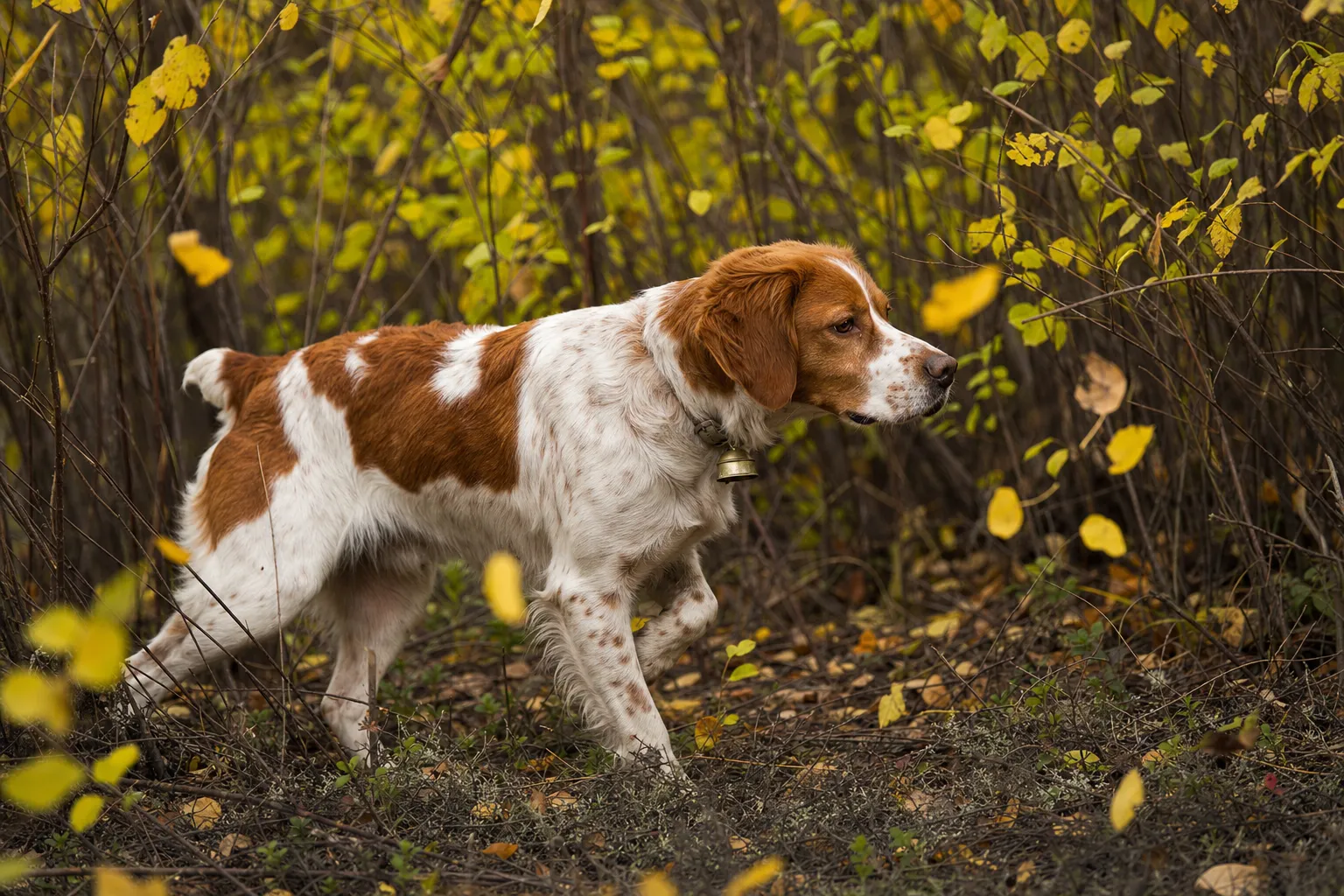

I hunt behind a Brittany, and here is what 30 years in the Northwoods taught me about the breed. If you want one dog that points grouse, retrieves what you knock down, rides quiet in the truck, and sleeps on the couch that night, this is the page for you.
Heritage
The Brittany started as a poacher’s dog in the hedgerow country of northwestern France. Small enough to pass as a farm dog, close-working enough to hunt quietly, and biddable enough to do it all under the landowner’s nose. That history built exactly the dog the grouse woods asks for.
It is the smallest of the pointing breeds, and that is not a weakness. A 35 pound dog slips through alder tangles that stop a bigger dog cold. French breeders wanted a compact dog that pointed, retrieved, and stayed within reach in tight cover. They got it, and American hunters figured out fast that the same package works in aspen cuts and grouse cover here.
One naming note. The AKC dropped “spaniel” from the name decades ago, so the breed is officially just the Brittany. Plenty of hunters still say Brittany spaniel, and everybody knows what they mean. The dog points, it does not flush, whatever you call it.
The Mystique
Ask a Brittany owner about the breed and you will get the same answer I give. They are amazing hunters, great pets, and real companions, and you stop being able to separate those three things after the first season.
My dogs have been my hunting partners in the truest sense. Not equipment, not livestock, partners. A Brittany watches you. He learns your routes, your pace, and the sound of the gun case coming off the shelf. By October he knows what day it is before you do.
The reputation the breed carries is the honest one. Soft, eager to please, a little sensitive, and wired to work with you rather than for himself. You do not fight a Brittany. You show him what you want and he spends the rest of his life trying to give it to you. Heavy hands ruin them, and the people who complain about the breed are usually the people who tried.
What surprises first-time owners is the off switch. The same dog that hunts four hours through blowdown is asleep on the couch by seven, head on somebody’s lap. Just as good on the couch as in the woods. That is not a slogan, that is my living room in November.
In the Grouse Woods
A Brittany hunts grouse close, and close is what kills grouse. Mine works 25 to 75 yards, checking back on his own, bending with the cover. When the aspen gets thick he shortens up without being told. You are rarely more than a minute from the point, and with ruffed grouse that minute is everything.
The pace is busy but not frantic. A Brittany quarters with purpose, works objectives, and slows into scent with that low, stalking creep before the point locks up. It is a staunch, honest point, and most Brittanys retrieve to hand without much formal work.
Run a bell or a collar anyway. Even a close dog disappears in leaf-on cover, and the silence when the bell stops is still the best sound in hunting. I run a bell early and add the collar’s point alert once the dog is out past hearing in the wind.
Running birds test every pointing dog, and grouse run more than people admit. A good Brittany learns to relocate carefully, breaking point and moving with the bird instead of crowding it. That is experience, not training, so forgive the young dog his bumped birds in year one.
The woodcock crossover is free money. The same October covers hold both birds, and woodcock sit so tight they are the best teachers a young Brittany ever gets. Mine has pointed hundreds of them between grouse finds, and I never once regretted it.
The Other Ten Months
A Brittany between seasons is an easy dog to live with, provided you move him every day. Mine gets a hard run or a long walk daily, more when the weather is good, and that is enough to keep the house calm.
This is a house dog, full stop. The breed bonds too hard to live in a kennel run, and a Brittany left alone and unworked will invent jobs you will not like. In the house he is quiet, clean, and medium-sized enough that nobody trips over him.
Summer is for conditioning and reminders. Retrieving drills in the yard, swimming when the lakes warm up, and a few sessions on planted birds or a check cord if the young dog got sloppy. Keep him lean through August and he is ready when the leaves turn. What I do most, honestly, is nothing special. He lives with us, he moves every day, and the woods do the rest.
Is This Your Dog?
Get a Brittany if you want a close-working grouse dog that doubles as a family dog, and you can commit to daily exercise and a soft hand. It is the best first pointing dog I know of. Forgiving, biddable, small enough to manage, and talented enough that the dog covers for your mistakes while you learn.
Skip the Brittany if you want a big-running prairie dog, a kennel dog, or a dog you can ignore from January to September. And be honest about temperament. If your training style is loud, this breed will shut down on you, and that is your fault, not the dog’s.
Buy from hunting lines. Ask to see the parents work if you can. A well-bred Brittany makes you look like a better trainer than you are.
Where to Go Next
If the Brittany’s size gives you pause, look at the German Shorthaired Pointer for a bigger, harder-charging versatile dog, or the Wirehaired Pointing Griffon for a close worker with a cold-weather coat. Read up on the bird itself in our ruffed grouse field guide, and match the dog to a gun with our 12 vs 20 vs 16 gauge grouse gun comparison. For the full breed rundown, start at the grouse dog hub.
FAQ
Brittany questions, answered
Are Brittanys good grouse dogs?
Yes, the Brittany is one of the best grouse dogs you can put on the ground. I have hunted ruffed grouse behind a Brittany in northern Minnesota for 30 years, and the breed's close range, natural point, and drive in thick cover fit the grouse woods almost perfectly. They handle woodcock just as well.
How far does a Brittany range in the grouse woods?
Most Brittanys work 25 to 75 yards in grouse cover, close enough that you can hear the bell and reach the point in time for a shot. Mine shortens up on his own when the cover thickens. Some American field lines run bigger in open country, but in the aspen they tighten naturally.
Do Brittany spaniels shed?
Yes, Brittanys shed a moderate amount year-round, with heavier seasonal sheds in spring and fall. The coat is short enough that it has never taken over my house. A weekly brushing handles most of it, and the flat coat picks up fewer burrs than a setter's feathering.
How long do Brittany spaniels live?
Brittanys typically live 12 to 14 years, and a sound dog can hunt hard for 10 or more of those seasons. It is a healthy, athletic breed with fewer structural problems than many larger pointing dogs. Keep one lean in the off-season and you get a long career in the woods.
Are Brittany spaniels good family dogs?
Yes, Brittanys are excellent family dogs as long as the family gives them real exercise. Mine is as good on the couch as he is in the woods. They are affectionate, gentle with kids, and small enough at 30 to 40 pounds to live comfortably in an ordinary house.
What is the difference between a Brittany and a French Brittany?
The American Brittany and the French Brittany, or Epagneul Breton, grew from the same French root stock along different lines. French dogs run smaller and closer, and black is an accepted color. American lines are leggier and tend to range wider. For grouse hunting, either style does the job.