

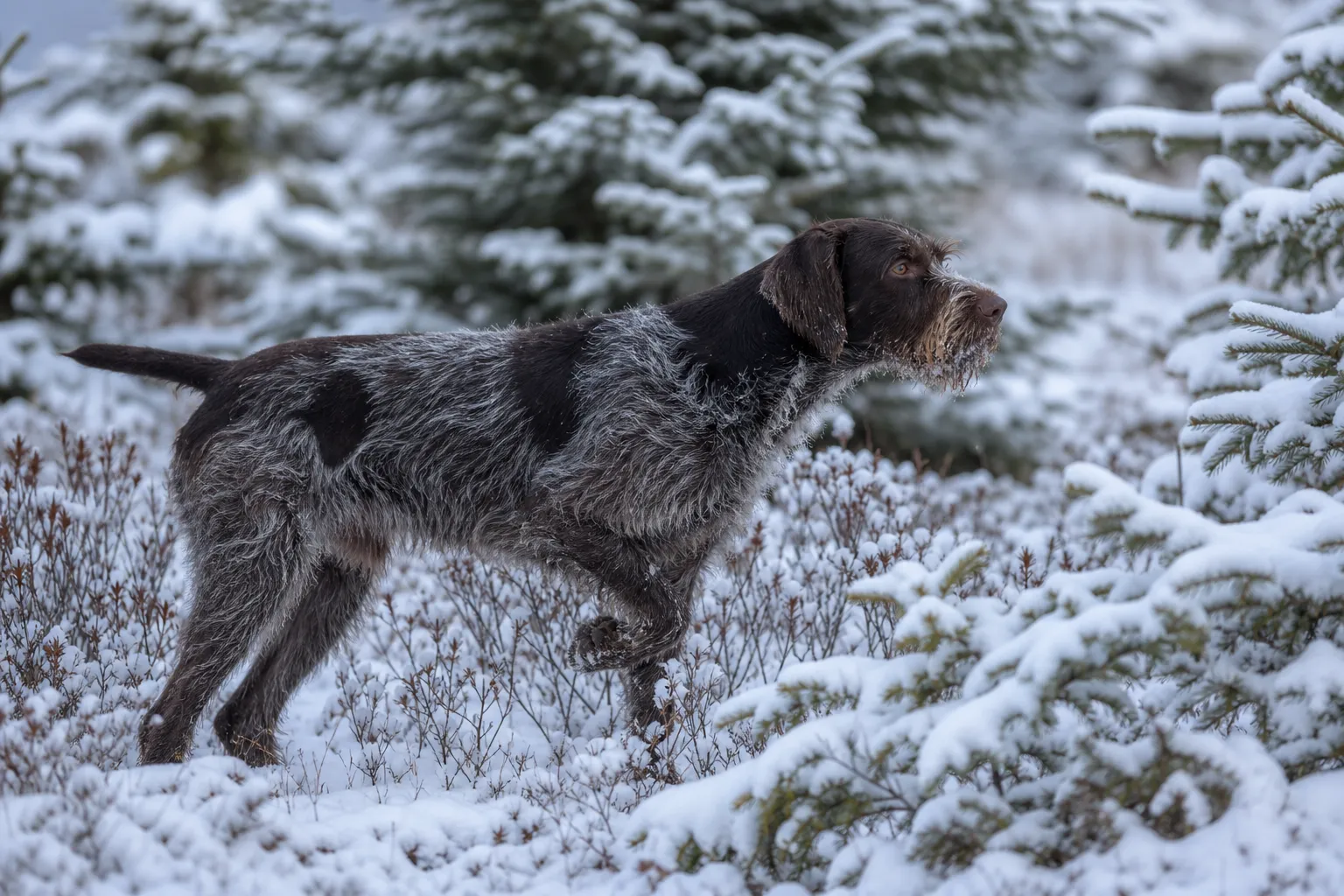

The Wirehaired Pointing Griffon is what happens when someone designs a gun dog for the weather that ends most hunts. Wire coat, beard full of frost, working close and steady through cover that shreds other dogs. If your best grouse hunting happens after the first snow, read this one carefully.
Heritage
The griffon is one man’s project. Eduard Korthals, a Dutch breeder working in France and Germany in the late 1800s, set out to build the complete walking hunter’s dog. One animal that pointed upland birds, retrieved from cold water, tracked wounded game, and wore a coat that made weather irrelevant. He bred ruthlessly toward that goal, and the dogs descending from his program still carry his name in Europe, where the breed is called the Korthals Griffon.
France gets listed as the country of origin and griffon people will happily argue Dutch versus French forever. What matters to a hunter is what Korthals prioritized. Not speed, not range, not field trial style. Function, coat, and cooperation. The griffon was never meant to outrun anything. It was meant to outlast everything.
That design brief reads like a grouse hunter’s wish list. The breed came to North America with the versatile hunting dog movement and found its natural home with foot hunters in cold states. In the aspen and alder of the northern grouse range, the griffon is not an adapted specialist. It is a close-working forest dog doing exactly what it was built for.
The Mystique
Griffon people lead with the phrase supreme gun dog, the tagline the breed has carried for generations. Behind the slogan is a quieter reputation that owners repeat with remarkable consistency. The griffon is the dog that never has a bad day.
The word that follows the breed around is steady. Steady in the truck, steady at camp, steady on the fourth hour of a cold hunt. Owners talk less about flash and more about trust, a dog that does the same honest job every time out. Where Pointer people brag about speed, griffon people brag that their dog has never once made them nervous.
Then there is the face. The beard and eyebrows give the griffon a scruffy, wise, slightly comic look that strangers cannot walk past, and owners swear the personality matches it. Goofy at home, serious in cover, and watching you the whole time in between. The breed’s followers are famously devoted, and most of them will tell you the same thing. They came for the hunting and stayed for the dog. Once the beard has slept next to the wood stove for a winter, most households never go back to a slick-coated breed.
In the Grouse Woods
A griffon hunts grouse close and deliberately, mostly 25 to 75 yards, at a trot-and-canter pace rather than a dead run. It is a thorough dog, working cover completely instead of skimming it. You will find fewer birds per mile than a big runner finds, and you will get shots at more of the ones you find.
That pace pays in thick stuff. A methodical dog bumps fewer grouse in tight cover, and the wire coat lets a griffon push into thorn and blowdown that thin-coated dogs learn to skirt. A bell is usually all you need to track a dog this close, though a collar with a point alert earns its keep when the wind is up. The point itself is staunch and the natural retrieve is a breed hallmark.
On running birds the griffon’s tracking heritage shows. It trails foot scent patiently and relocates rather than crowding, which is exactly the treatment a running grouse needs. Woodcock crossover is complete. A close, careful dog in October woodcock cover is about as productive as pointing dog work gets.
The breed’s biggest grouse-woods advantage arrives late. When December wind and snow end the season for other dogs, the griffon’s double coat is just getting comfortable.
The Other Ten Months
A griffon between seasons is the easiest keep among the pointing breeds on this site. It needs real daily exercise, a run, a swim, a long walk with time off leash, but it lacks the frantic edge of a shorthair. Exercised, it is a calm and slightly comedic house dog.
It must be a house dog. Griffons attach to their people intensely and do badly in kennels or empty houses. This breed’s worst enemy is not cold or thorns, it is isolation.
The coat is the off-season chore. Weekly brushing, occasional hand-stripping to keep the wire texture, and a beard that transfers water from the bowl to your leg every single day. In exchange you get minimal shedding and a dog that dries fast and rarely smells. Summer work is simple, retrieving and water drills, and griffons love water work.
Is This Your Dog?
Get a griffon if you hunt grouse on foot in cold country, want a close dog you rarely lose track of, and want a genuine family companion the other ten months. It is a strong first pointing dog, forgiving and cooperative, so long as you accept the grooming and the velcro temperament.
Skip the griffon if you want speed and big range, if the dog will live outside, or if a wet beard on your knee sounds like a dealbreaker rather than a charm. Hunters who love watching a dog eat up country will find the griffon’s pace frustrating. Demand for well-bred pups often outruns supply, so expect a waitlist from good hunting kennels rather than an available litter.
Where to Go Next
The griffon’s closest rival for the same job is the German Shorthaired Pointer, faster and wider from the same versatile tradition. If you want close-working in a smaller, softer package, read the Brittany. See why late-season birds reward a cold-weather dog in our ruffed grouse field guide, and pair the dog with the right gun in the 12 vs 20 vs 16 gauge grouse gun comparison. Every breed we cover is compared at the grouse dog hub.
FAQ
Wirehaired Pointing Griffon questions, answered
Is a Wirehaired Pointing Griffon a good grouse dog?
Yes, the Wirehaired Pointing Griffon is one of the best-suited breeds for grouse hunting. It works close, points staunchly, retrieves naturally, and wears a wire coat that shrugs off the thorns and cold that punish thin-coated dogs. For late-season grouse in snow, few breeds fit the job better.
How far does a Griffon range in the grouse woods?
Most griffons work 25 to 75 yards in grouse cover, a naturally close and methodical range. The breed hunts with you rather than for the horizon, checking back often. That deliberate pace means fewer bumped birds in thick cover, and it makes the griffon one of the easiest pointing breeds to keep track of.
Do Wirehaired Pointing Griffons shed?
Griffons shed very little, the least of any breed a grouse hunter is likely to own. The harsh wire coat holds dead hair until it is stripped or brushed out. The tradeoff is grooming. The coat needs regular brushing and occasional hand-stripping, and the famous beard carries water and dirt into the house daily.
Are Wirehaired Pointing Griffons good family dogs?
Yes, griffons are outstanding family dogs, gentle, loyal, and calmer in the house than most pointing breeds. They bond hard to their people and do poorly in kennels or left alone for long stretches. Give one daily exercise and family life, and it is as steady a companion as the gun dog world offers.
Why is the Griffon called the supreme gun dog?
Supreme gun dog is the tagline the griffon community has attached to the breed for generations, and it reflects Korthals' original goal of one dog for every kind of hunting. The griffon points, retrieves on land and water, tracks, and handles brutal weather. The nickname is marketing, but the versatility behind it is real.