


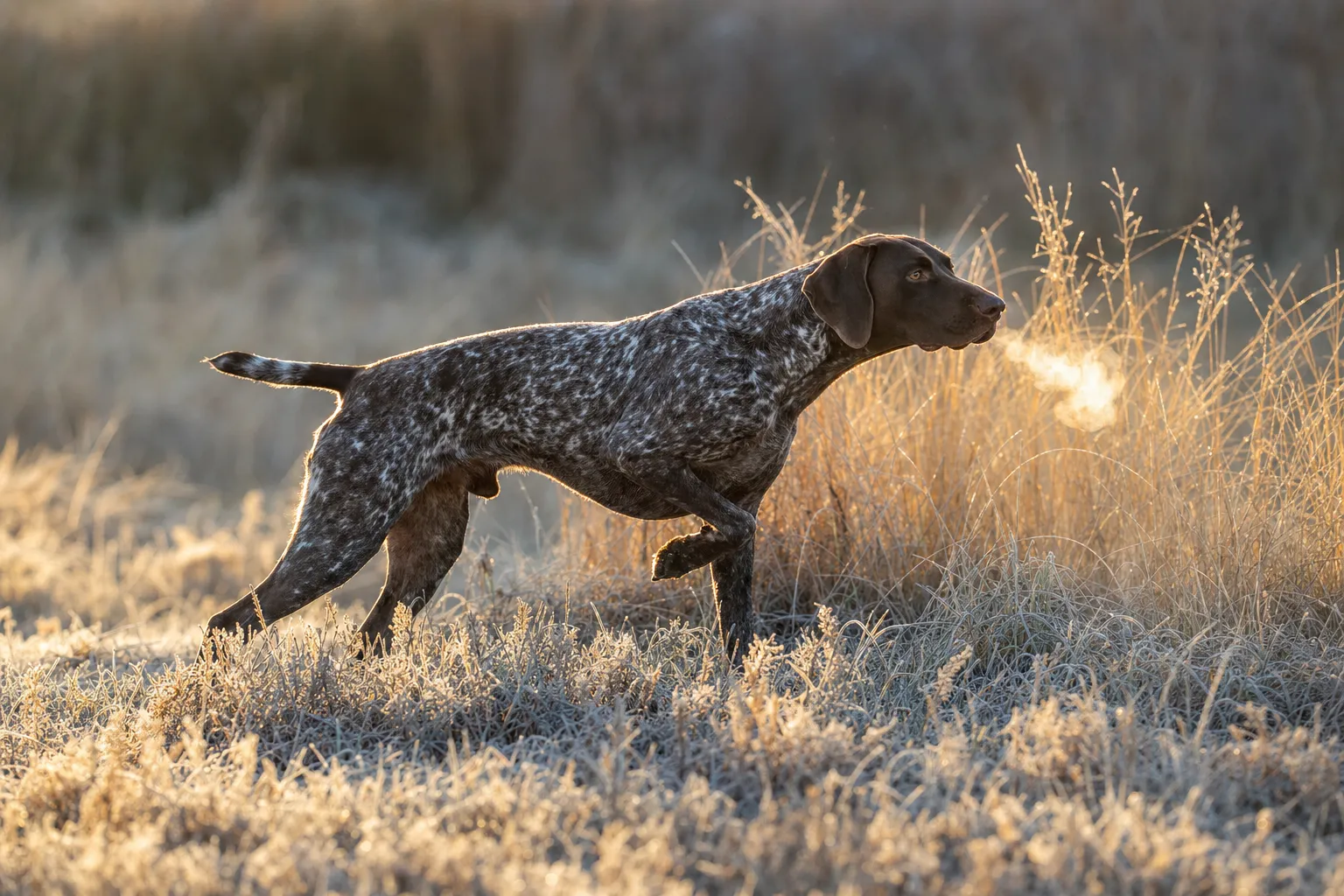

The German Shorthaired Pointer is the dog you buy when you refuse to specialize. It points grouse in October, breaks ice for ducks in November, and tracks a crippled rooster across a cut cornfield in December. Here is how the do-everything German fits the specific job of ruffed grouse.
Heritage
The GSP was built in 19th century Germany to be one dog for everything. German hunters could not kennel a specialist for each species, so they bred a single dog to point upland birds, retrieve from water, and track fur and feather alike. Pointer speed crossed onto hound nose and retriever water drive, all in one short-coated package.
That versatile tradition crossed the Atlantic intact. The North American Versatile Hunting Dog Association, NAVHDA, grew up largely around breeds like the GSP, testing dogs on pointing, retrieving, and tracking rather than a single skill. GSP culture in this country still runs through those testing grounds, and it shows in the breeding. A well-bred GSP is expected to do everything, not just look stylish doing one thing.
The grouse woods were never the breed’s design target. The GSP came here as a pheasant, duck, and everything dog. But hunters in Minnesota, Wisconsin, and Michigan kept finding that the everything dog handled partridge cover just fine, and the breed earned its spot in the aspen on results.
The Mystique
The GSP’s reputation is motion. Owners describe a dog that hits the cover like it owes him money, hunts to the last minute of daylight, and asks for more in the truck. Nobody brags about a GSP being calm. They brag about the drive, and the drive is real.
What outsiders miss is the attachment underneath it. GSPs are velcro dogs. The same animal that runs like a machine in the field wants to be leaning against your leg the rest of the day. Owners joke that a GSP’s two settings are wide open and in your lap, and the joke holds up because it is true.
The other piece of the lore is honesty. A GSP does not sulk and does not quit. Hunt one in rain, in snow, through the worst blowdown on the worst day of the season, and the dog’s effort never drops. Hunters who run GSPs tend to run them for life, and when you ask why, the answer is usually some version of the same thing. The dog always shows up. Every hunt, every hour, all effort. There is something steadying about a partner like that.
In the Grouse Woods
A GSP hunts grouse at medium range, roughly 50 to 150 yards, and the good ones tune that to the cover. In open hardwoods the dog stretches. In thick alder bottoms a woods-experienced GSP shortens up and checks back. That adjustment is learned, so a young GSP’s first season in grouse cover will test your patience and your legs.
The pace is fast and forward. A GSP covers ground in big reaching casts rather than the tight quartering of a Brittany, which means it finds more birds per hour and points some of them out of sight. Run a bell and a locating collar both. Leaf-on cover swallows a shorthair, and the collar’s point alert saves birds a bell cannot.
On running grouse the GSP has an edge, because tracking is in the job description. A versatile-bred dog trails a running bird with its nose down, relocates, and pins it rather than standing on stale scent. Woodcock crossover is automatic. The same dog points timberdoodles all day, though some GSPs need a season to decide woodcock are worth retrieving.
The Other Ten Months
A GSP between seasons is a serious exercise commitment, and there is no way to soften that. This breed needs hard daily work, running, swimming, fetching, roading off a bike, something that burns real energy. A walk around the block is a warmup, not a workout.
Give the dog that outlet and the house side is easy. GSPs are clean, short-coated, affectionate, and quiet indoors once the tank is empty. Skip the outlet and the breed’s demolition reputation is earned. Chewed trim, dug yards, and a dog that vibrates.
Summer is where NAVHDA culture pays off even for non-members. Training days, water work, and tracking drills keep a versatile dog sharp and sane through the off-season. A GSP wants a job every month of the year. The hunters who thrive with the breed are the ones who like giving it one.
Is This Your Dog?
Get a GSP if you hunt more than grouse and you live an active life. For the hunter who wants one dog for grouse, pheasants, ducks, and everything else, the shorthair is the default answer for good reason. It is trainable enough for a committed first-time owner who has honest exercise capacity.
Skip the GSP if grouse are your only bird and you want a close, quiet specialist. A Brittany or a griffon gives you the tight range without the mileage requirement. And skip it if your dog will be alone in a yard all week. That dog will break your fence and your patience.
Buy from proven hunting or NAVHDA-tested lines and ask about range on both parents. GSP litters vary, and the woods hunter wants the closer end of the breed.
Where to Go Next
If you like the versatile idea but want a closer, calmer dog, read the Wirehaired Pointing Griffon. If you want smaller and softer, the Brittany is the classic answer. Study the bird in our ruffed grouse field guide, then pick a gun that keeps up with a fast dog in our 12 vs 20 vs 16 gauge grouse gun comparison. Compare all nine breeds at the grouse dog hub.
FAQ
German Shorthaired Pointer questions, answered
Is a GSP a good grouse dog?
Yes, a German Shorthaired Pointer is a very good grouse dog when it learns to shorten its range for thick cover. The breed's nose, staunch point, and natural retrieve all translate to the grouse woods. A GSP from close-working lines, hunted in cover young, handles ruffed grouse as well as any versatile breed.
How far does a German Shorthaired Pointer range when hunting?
Most GSPs range 50 to 150 yards in the grouse woods and much farther in open country. The breed adjusts to cover better than its field trial reputation suggests. An experienced grouse GSP learns to check back and hunt inside shotgun-supporting distance, though it takes a season or two of woods work.
Do German Shorthaired Pointers shed?
Yes, GSPs shed steadily year-round despite the short coat. The stiff, short hairs work into upholstery and truck seats and are harder to clean up than longer fur. A rubber curry brush once a week keeps it manageable. The upside for a grouse hunter is a coat that sheds burrs and dries in minutes.
Are German Shorthaired Pointers good family dogs?
Yes, GSPs are affectionate, people-oriented family dogs, but only in an active household. This is the highest-energy breed on most grouse hunters' short lists, and an under-exercised GSP is a wrecking ball. Give one daily hard exercise and it is a loyal, gentle house dog that adores kids.
What does NAVHDA mean for a grouse hunter buying a GSP?
NAVHDA is the North American Versatile Hunting Dog Association, and its testing system is the best proof of working ability a GSP buyer can ask for. Breeders who run Natural Ability and Utility tests are breeding dogs that point, retrieve, and track. For a grouse hunter, NAVHDA scores in a pedigree beat show ribbons every time.