


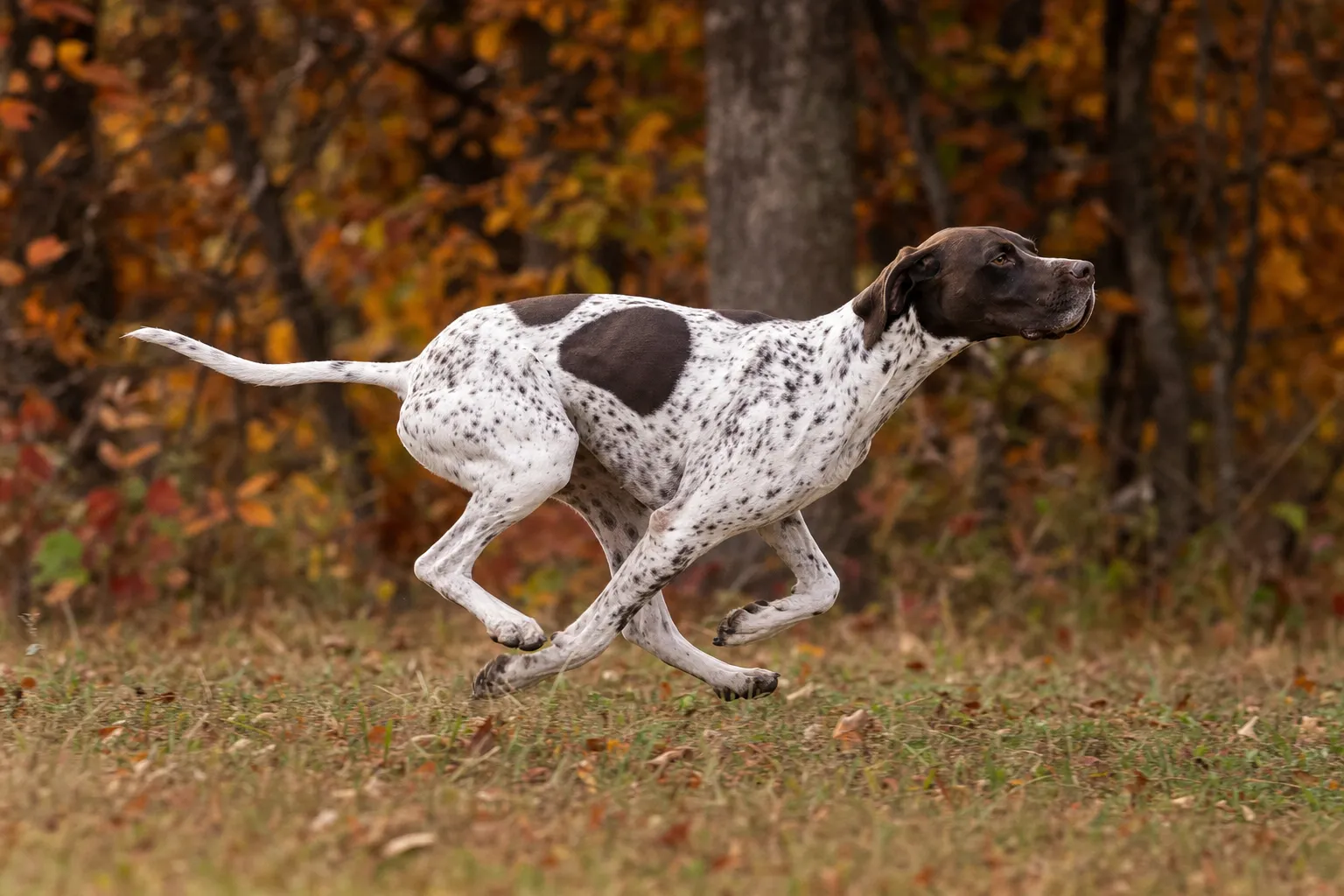

The Pointer is the fastest, widest, hottest-blooded pointing dog in the field, and dropping one into a Minnesota aspen cut is either brilliant or foolish depending on who you ask. Both sides of that argument deserve a fair hearing, because this breed on grouse is a real debate, not a settled question.
Heritage
The Pointer is field trial royalty. Bred in England for centuries and refined in America on quail plantations and the all-age trial circuits, the breed was shaped for one picture. A white dog streaking across open country, slamming into a point at 400 yards, standing like a statue until the handler arrives on horseback.
Nothing about that picture says grouse woods. And yet Pointers have hunted grouse for generations, because a serious minority of grouse hunters decided the breed’s assets outweigh the fit problem. No pointing dog carries a better nose, more style on point, or deeper stamina. The grouse trial world, including the cover dog circuits of the Northeast and Great Lakes, has long run Pointers alongside setters in the thickest cover in the sport, and the dogs win there.
The honest debate is about range. Critics say a big-running dog in thick cover means points you never find and birds bumped out of range. Believers answer that a Pointer with woods experience handles its range, that a GPS collar solved the lost-point problem, and that a dog covering triple the ground finds triple the birds. Both sides are telling the truth. Which truth matters more depends on you.
The Mystique
The Pointer’s aura is intensity. Owners talk about a dog that runs to the horizon on the first cast of the day and hits the same gear on the last, a motor that never falls off. In a sport full of good dogs, the Pointer is the one other handlers stop to watch.
The style is the other half of it. A Pointer on point is high-headed, high-tailed, and cranked tight, and even hunters who would never own one admit the picture stops your breath. There is a reason the breed has dominated major field trials for a century. When bird finding is scored ruthlessly, Pointers keep winning.
Off the ground, the breed surprises people. The reputation says hard-headed running machine. The dog on the couch is soft, almost needy, a leaner and a lap-crawler with an expression that has been melting owners for generations. Pointer people talk about that contrast constantly. The wildest dog in the field is the gentlest one in the house.
It is not a breed that inspires mild opinions. Hunters who run Pointers tend to run nothing else and say so often. The rest of the sport watches from a respectful distance, half skeptical and half envious, which suits Pointer people fine.
In the Grouse Woods
A Pointer hunts grouse big. Even a woods-broke dog works 75 to 150 yards in cover where a Brittany works 40, and a young or prairie-bred Pointer runs far beyond that. The dog finds more birds than a close worker. The question every hunt answers is how many of those finds turn into shots.
A GPS collar is not optional. A bell helps in the close and middle work, but a Pointer will be out of bell range regularly, and the collar’s point screen is how you hunt this breed in the woods now. When the collar says point, 220 yards, you walk fast and trust the dog to hold. Staunchness is the whole game, and it is the strongest card the breed holds. A broke Pointer stands birds a long time.
Running grouse are the hard case. A bird that runs from a point 200 yards away is usually gone before you arrive. Experienced Pointers learn to handle running birds with relocations, but the math favors closer dogs here. Woodcock are the consolation prize. They hold so tight that even a big dog’s points turn into shots, and Pointers point them as well as anything alive.
Pace-wise, plan on the dog out-hunting you. A Pointer does not slow down because you are tired.
The Other Ten Months
A Pointer between seasons needs serious running, and the yard will not cover it. Roading, biking, or big off-leash country several days a week keeps the motor maintained. This is a lean, hard-muscled athlete, and it stays healthy by staying in work.
In the house, a conditioned Pointer is calmer than its reputation. The breed is short-coated, clean, and deeply affectionate, happiest sleeping somewhere against a person. The thin coat means it is not an outdoor dog in northern winters, whatever the old kennel culture said. Cold months, the dog belongs inside.
Training upkeep matters more with this breed than most. Range discipline erodes without reinforcement, so summer check cord work and steady contact keep the woods manners you spent two seasons building. A Pointer left rough for ten months rewilds by opening day.
Is This Your Dog?
Get a Pointer if you are an experienced handler, you cover big country, and you would rather find ten birds and shoot at four than find five and shoot at four. Hunters who mix grouse with prairie birds get the most from the breed, because the Pointer is the one dog on this site that is never over-dogged in open country.
Skip the Pointer if this is your first bird dog, if you hunt small woodlots, or if a dog out of sight makes you anxious. Nothing about this breed will fix that, and a frustrated handler ruins a good Pointer fast. Buy from cover dog or woods hunting lines, never from all-age trial stock, and ask hard questions about the range of both parents.
Where to Go Next
For big-going style with a woodsier reputation, read the English Setter, the Pointer’s historic rival in grouse cover. For the opposite philosophy, a close dog always in sight, see the Brittany. Learn why grouse punish long points in our ruffed grouse field guide, and choose a fast-handling gun in the 12 vs 20 vs 16 gauge grouse gun comparison. All nine breeds are compared at the grouse dog hub.
FAQ
Pointer questions, answered
Is a Pointer a good grouse dog?
A Pointer can be an excellent grouse dog, but it is a specialist's choice, not the default. The breed's nose, style, and stamina are unmatched, and its natural range is built for open country rather than aspen thickets. A Pointer from close-working woods lines, in experienced hands, is deadly on grouse.
How far does a Pointer range when hunting?
Pointers commonly range 150 to 400 yards and beyond, farther than any other breed grouse hunters run. In the woods a well-handled Pointer shortens to 75 to 150 yards, which is still big for grouse cover. That range demands a GPS collar and a handler comfortable shooting birds over a dog found, not seen.
Can a big-running Pointer learn to work close in grouse cover?
Yes, most Pointers adjust their range to cover, and woods experience shortens them further. Grouse trial strings prove the breed can handle tight cover at workable distances. But you are managing the breed's nature, not changing it. A hunter who wants a 40 yard dog should buy a closer breed instead.
Are Pointers good family dogs?
Yes, Pointers are gentle, sweet-natured house dogs once their exercise needs are met, and that is a large once. The breed is affectionate and good with kids but wired for miles of running. An under-exercised Pointer in a sedentary home is a hard keep. In an active one it settles surprisingly well.
What is the difference between a Pointer and an English Pointer?
Nothing, they are the same breed. The registries call it simply the Pointer, and hunters added English to distinguish it from German pointing breeds like the GSP. If a breeder advertises English Pointers, you are looking at the same field trial breed described on this page.