


Heritage
The English Springer Spaniel is the oldest idea in wingshooting. Before pointing dogs, before breech-loaders, spaniels “sprang” game for nets and falcons in the hedgerows of England. The name is the job description. When shotguns arrived, the springing spaniel became the flushing spaniel, and the job barely changed.
The breed sorted itself out in England in the 1800s, when spaniel types were still divided mostly by size out of the same litters. The bigger, leggier dogs became Springers. By the early 1900s the breed was established on both sides of the Atlantic, and American hunters put it to work on pheasants, woodcock, and grouse.
Then the split happened. Field trials rewarded drive, nose, and pace. Dog shows rewarded coat and conformation. Over generations the field-bred Springer and the show-bred Springer became two different dogs wearing the same name. For a grouse hunter this is the single most important fact about the breed. A field-bred Springer from working lines is a serious bird dog. A show-line dog is a handsome pet. Buy accordingly.
The Mystique
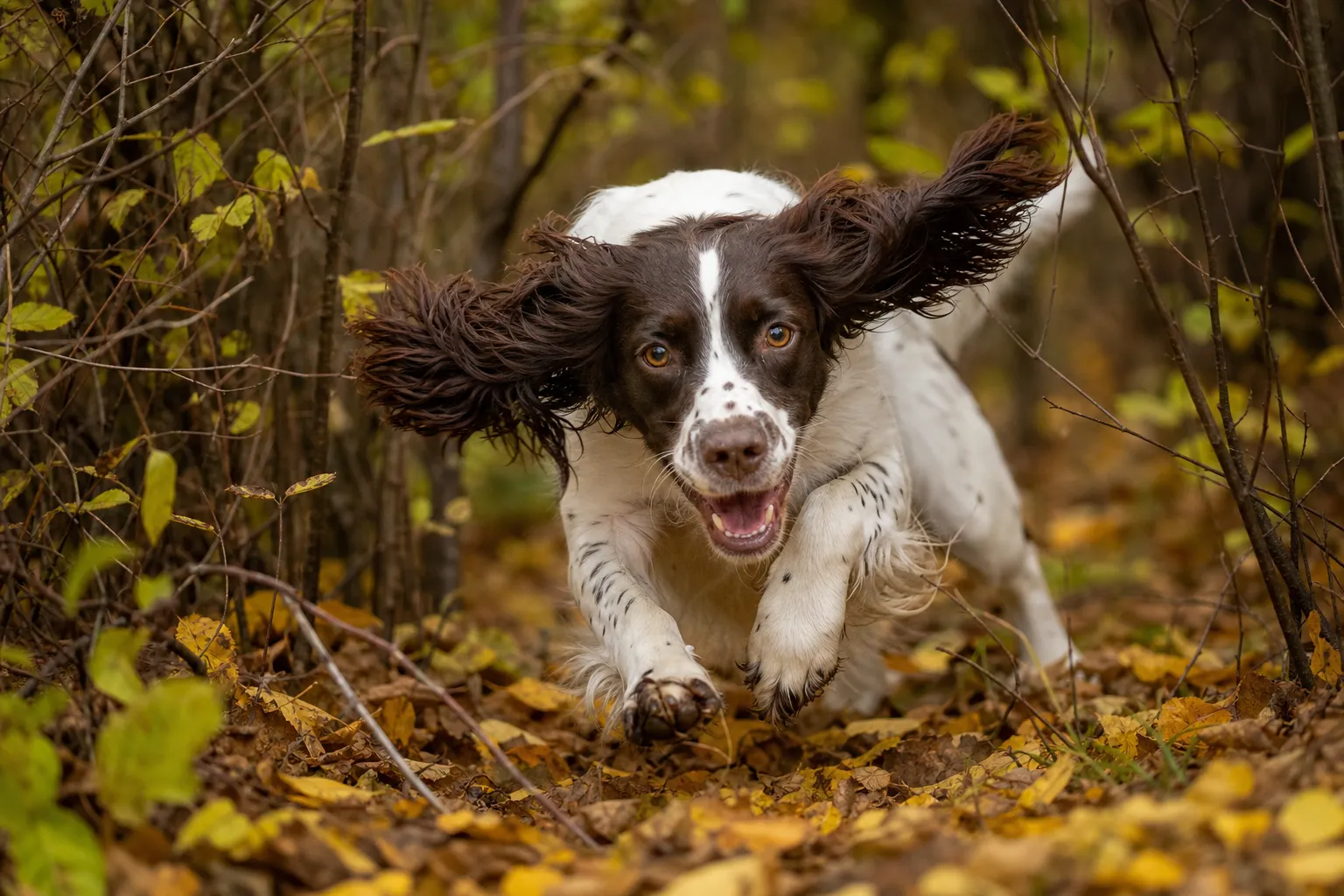
Springer people talk about merriment, and they are not being cute. The breed hunts with a wagging, boiling happiness that is visible from across a clearcut. The stub tail never stops. Old-timers judged a spaniel by that tail, because when it goes from steady beat to blur, a bird is close and you had better be ready.
The mystique is partnership at close quarters. A pointing dog can be a distant artist you find by bell or beeper. A Springer is never more than a shotgun pattern away, checking in, reading your line, bending its cast to your pace. Hunters who run them describe something close to telepathy by the third season, a dog that knows which alder run you intend to work before you turn.
There is also the quiet pride of the two-way dog. A Springer flushes the bird and then fetches it, and the retrieve is not an afterthought. Soft mouth, strong desire, delivered to hand. In grouse cover, where a downed bird can vanish into ferns three feet from where it fell, that finish matters as much as the flush. The Springer’s reputation was built on never leaving a bird behind.
In the Grouse Woods
The Springer earns its keep where pointing dogs struggle, in cover too thick to point. Some grouse woods are so dense that a point 40 yards in is useless because you cannot get there before the bird walks off. A Springer solves the problem by hunting the cover you can actually shoot over.
The pattern is a quartering cast, back and forth in front of the gun, ideally inside 25 to 30 yards. Grouse do not sit as politely as planted pheasants, so the dog learns to push scent hard and fast, forcing the flush before the bird can run out the side. When it works, the bird lifts in range and going away, which is the best shot the grouse woods ever offers.
A bell or beeper collar is worth running even on a close dog, because thick October foliage swallows a 45 pound spaniel whole. Silence from the bell means the dog is on scent and driving. That is your cue to move.
Running birds play to the breed’s strength. Where a pointer gets picked apart by a grouse that will not hold, a Springer just stays on the track and makes the bird fly. And on woodcock the Springer is money. Woodcock sit tight, flush close, and fall in cover that demands a retrieving dog. A Springer and an October woodcock flight is about as sure a thing as upland hunting has.
The Other Ten Months
A field-bred Springer lives well in the house, but it is not furniture. Expect a 40 to 50 pound dog with a motor, a dog that wants a job every single day. A long walk helps. Retrieving drills, swimming, and short training sessions help more, because the Springer brain needs work as much as the legs do.
Between seasons, keep the pattern sharp. Ten minutes of quartering drills in a field, a few hand signals, a check on steadiness, and the dog stays honest for September. Springers are biddable and forgiving, which makes off-season training more pleasure than chore. Neglect it and the dog will still hunt in the fall, just wider and wilder than you want.
In the house they are companionable to a fault, underfoot, attached, happiest touching someone. The coat carries burrs home from every walk and sheds year round, so keep a comb by the door. Most field Springers make poor kennel dogs. They want to be with you, and they are better dogs for it.
Is This Your Dog?
Get a Springer if you hunt thick grouse and woodcock cover, want every flush inside gun range, and value a dog that retrieves as well as it finds. It is a genuine first bird dog. The breed is forgiving of amateur training and small enough for any truck or house.
Skip the Springer if you want the pointing experience, the frozen dog and the walked-up flush. No amount of training makes a flusher into a pointer, and you should not want it to. Skip it too if the dog will be alone in a yard all week. A bored Springer is a loud, destructive Springer.
Be picky about breeding. Ask for field-titled pedigrees, hips and eyes checked, parents that hunt. The field versus show split is real, and the paperwork is how you land on the right side of it.
Compare the Springer with the Labrador Retriever, the other flushing choice, or see how the pointing life differs with the Brittany and English Setter. Read up on the bird itself in the ruffed grouse guide, find the right gun in the 12 vs 20 vs 16 gauge comparison, and see all nine breeds side by side at the grouse dogs hub.
FAQ
English Springer Spaniel questions, answered
Is an English Springer Spaniel a good grouse dog?
Yes, a field-bred English Springer Spaniel is an excellent grouse dog. Springers work close, push birds into the air inside gun range, and thrive in the thick young cover ruffed grouse live in. The key word is field-bred. Buy from proven hunting lines, not show lines, and you get a dog built for the grouse woods.
What is the difference between a flushing dog and a pointing dog?
A flushing dog drives the bird into the air within gun range, while a pointing dog freezes and holds the bird until the hunter walks in. With a flusher you shoot the instant the bird lifts, so the dog must stay close. With a pointer the dog can range wider because the bird waits. Both styles kill grouse. They just ask different things of the hunter.
What is the difference between a field-bred and show-bred Springer?
Field-bred Springers are bred to hunt and show-bred Springers are bred for the ring, and the two lines have diverged for generations. Field dogs tend to be smaller and lighter coated with far more bird drive. A show-line Springer can still enjoy the woods, but a hunter should buy from field lines with hunting titles in the pedigree.
How far does an English Springer Spaniel range when hunting?
A trained Springer works inside 25 to 30 yards, close enough that every flush is a shootable flush. That windshield-wiper pattern in front of the gun is the whole point of the breed. If a flushing dog gets out past gun range, the birds it puts up are wasted, so training centers on keeping the dog in that pocket.
Are English Springer Spaniels good family dogs?
Yes, field-bred Springers are affectionate house dogs that attach hard to their people. They are merry, biddable, and good with kids when exercised. The tradeoff is energy. A Springer that does not get daily work will find its own projects, so plan on real exercise between seasons.