


Heritage
The Labrador Retriever started as a fisherman’s dog, not a bird dog. Its ancestors were the water dogs of Newfoundland, hauling nets and lines in the cold North Atlantic. British sportsmen brought them home in the 1800s, refined them into retrievers for driven shoots, and the modern Lab took shape in England from that Canadian stock.
Nothing in that history says grouse. The Lab came to the grouse woods the practical way, one pickup truck at a time. American hunters bought Labs for ducks, then figured the dog might as well come along in October when the aspens turned. It turned out a smart, biddable retriever with a good nose could learn the uplands just fine.
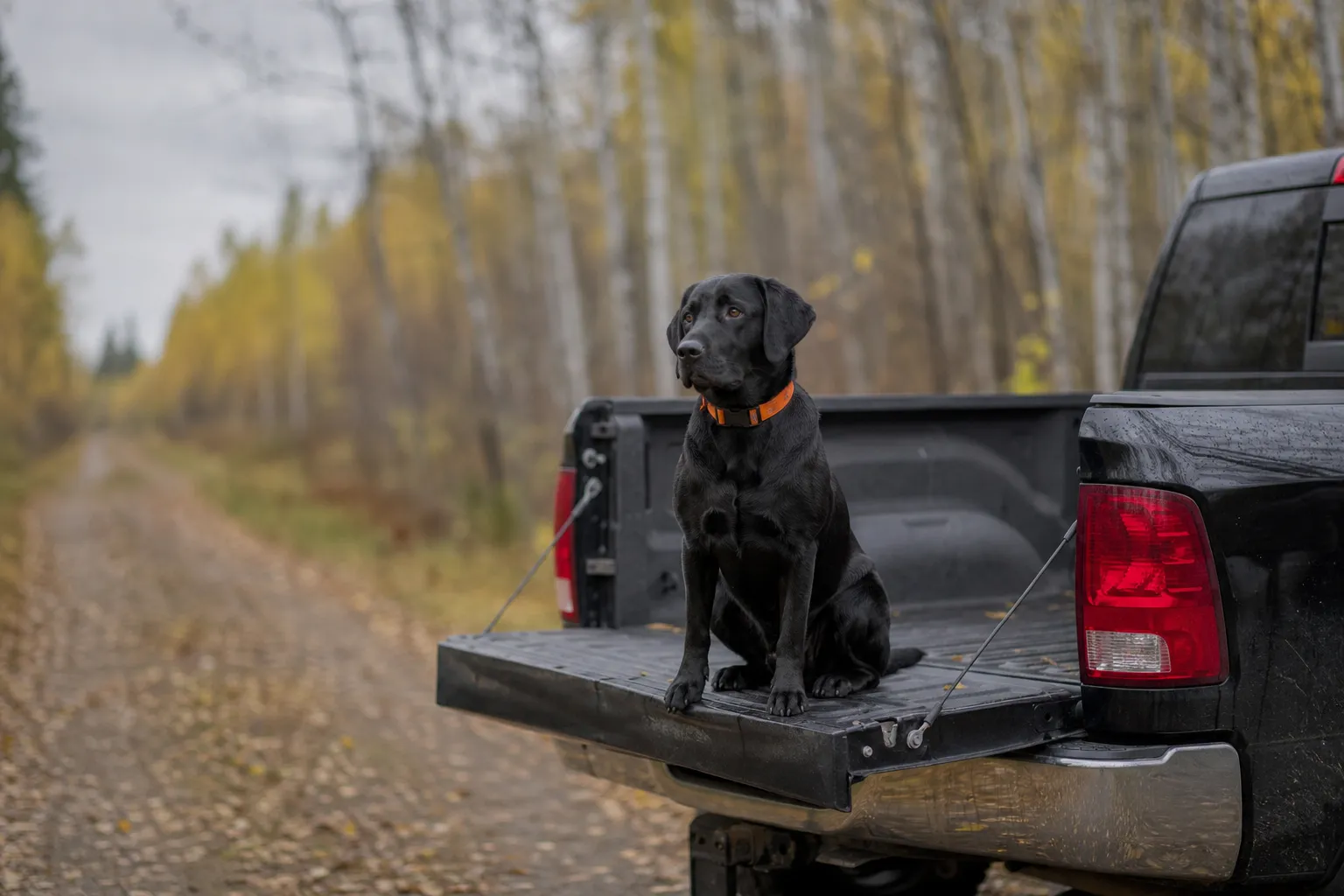
Walk any trailhead parking lot in northern Minnesota on a Saturday in October and count the dog boxes. Half of them hold a Lab. Not because the Lab is the best grouse dog ever made, but because it is the dog these hunters already own, already trust, and already love. The everyman’s grouse dog is not a slight. It is the whole story.
The Mystique
The Lab’s mystique is that it has none, and hunters find that a relief. No fussy coat, no delicate temperament, no lore about old bloodlines you were supposed to have researched. The Lab is the dog that just does the job, then puts its head on your knee at the diner drive-thru on the way home.
What owners swear by is the want-to. A Lab will hit cold water in December, bust a berry tangle in October, and drag itself off the couch at 5 a.m. with its tail already going, all for the privilege of being included. The desire to please is so deep in the breed that training feels less like teaching and more like agreeing on terms.
And there is the retrieve. Whatever else happens in the grouse woods, a bird that falls to a Lab gets found. Hunters who have lost a grouse in thick ferns behind a marginal dog do not forget it, and many of them bought a Lab afterward. The breed’s promise is simple and it keeps it. Every bird you knock down comes back to your hand. That, more than anything, is why the truck boxes are full of them.
In the Grouse Woods
Be honest about what a Lab is in grouse cover. It is a flushing dog by default rather than design, a retriever moonlighting in the uplands. It does the job well when trained and poorly when just let loose to gallop.
Range is the whole game. A Lab bombing around at 50 yards flushes grouse you never see. The dog you want works inside 20 to 30 yards, checking in, bending with you through the cover. Labs do not quarter by instinct the way a Springer does, so build the pattern with a whistle and early bird contact. A steady, close Lab in the aspens is a legitimately effective grouse dog.
A bell or beeper helps in thick stuff, though a close Lab is easier to track by ear than most breeds. Big dark dog, heavy footfall, you mostly know where it is.
Running grouse do not bother a Lab much. It follows foot scent and forces the flush, same as any flusher. On woodcock the Lab does honest work too, and some refuse to pick the bird up after the flush, which owners learn to laugh about. Where the Lab beats every pointing breed outright is the retrieve. A grouse down in a beaver pond edge or across a creek is a lost bird behind many dogs and a routine fetch behind a Lab.
The Other Ten Months
This is where the Lab wins the argument for a lot of hunters. Come January the specialist bird dogs go into maintenance mode. The Lab just changes jobs. Duck season, goose season, shed hunting, ice-out swims, a kid’s t-ball game. It shows up for all of it.
In the house the Lab is famously easy. Stable, tolerant, good with children and other dogs, fine with guests. The energy is real, especially the first three years, and a bored young Lab will eat a couch with real commitment. An hour of hard exercise a day and regular retrieving work keeps the machine running smooth.
Off-season upkeep is mostly retrieving drills and swimming, which the dog treats as payment rather than work. Keep weight off. Labs are shameless food thieves, and a fat Lab in September is a heat casualty waiting to happen in the early grouse woods. The short coat sheds more than people expect, twice a year in drifts, but it carries no burrs home and dries fast.
Is This Your Dog?
Get a Lab if you hunt more than one kind of bird, if the dog has to double as a family dog, or if this is your first hunting dog. It is the most forgiving breed on this list to train, the easiest to live with, and the one whose failure mode is still a pretty good dog.
Skip the Lab if grouse are your whole life and you want maximum bird contacts per hour. A close-working pointing dog or a field-bred spaniel will move more grouse in a season, and the pointing breeds give you the staunch dog on point that a Lab never will. Skip it too if 70 pounds of enthusiasm does not fit your truck, your house, or your patience.
If you go looking, favor field lines with hunt test or trial titles and health clearances on hips, elbows, and eyes. The gap between working and show Labs is smaller than in Springers, but drive still follows the pedigree.
See how the Lab stacks up against the English Springer Spaniel, the other flushing breed, or explore the pointing path with the German Shorthaired Pointer. Learn the bird in the ruffed grouse guide, sort out your gun with the 12 vs 20 vs 16 gauge comparison, and compare all nine breeds at the grouse dogs hub.
FAQ
Labrador Retriever questions, answered
Is a Labrador Retriever a good grouse dog?
Yes, a well-trained Lab is a good grouse dog, though it is a generalist rather than a specialist. A Lab that works close will flush grouse in gun range and retrieve every bird that falls. It will not cover ground like a setter or quarter like a field Springer, but it gets birds in the bag and hunts ducks the same weekend.
Do Labs point?
No, the Lab is a flushing dog, not a pointing breed. Some Labs flash-point, pausing for a beat on hot scent, and a few kennels breed pointing Labs on purpose, but the breed's job is to flush birds within gun range and retrieve them. If a staunch point is what you want, buy a pointing breed.
How far does a Lab range when hunting?
A trained Lab should work inside 20 to 30 yards in grouse cover. Labs are not natural quartering dogs the way spaniels are, so that close pattern comes from training, not instinct. Teach it early with check-ins and a whistle, because a flush at 60 yards is just a grouse you watched leave.
Are Labs good family dogs?
Yes, the Lab is arguably the best family dog among all the hunting breeds. It is patient with kids, friendly with strangers, and stable in the house. There is a reason it topped American breed registrations for decades. Just budget for exercise, because a young Lab without work is a wrecking ball with a tail.
Can the same Lab hunt grouse and ducks in the same weekend?
Yes, and that versatility is the best argument for a Lab. The same dog can flush grouse in the aspens Saturday morning and break ice for mallards Sunday. No pointing breed and few spaniels handle cold water like a Lab. If your season splits between the uplands and the duck blind, one good Lab covers both.