


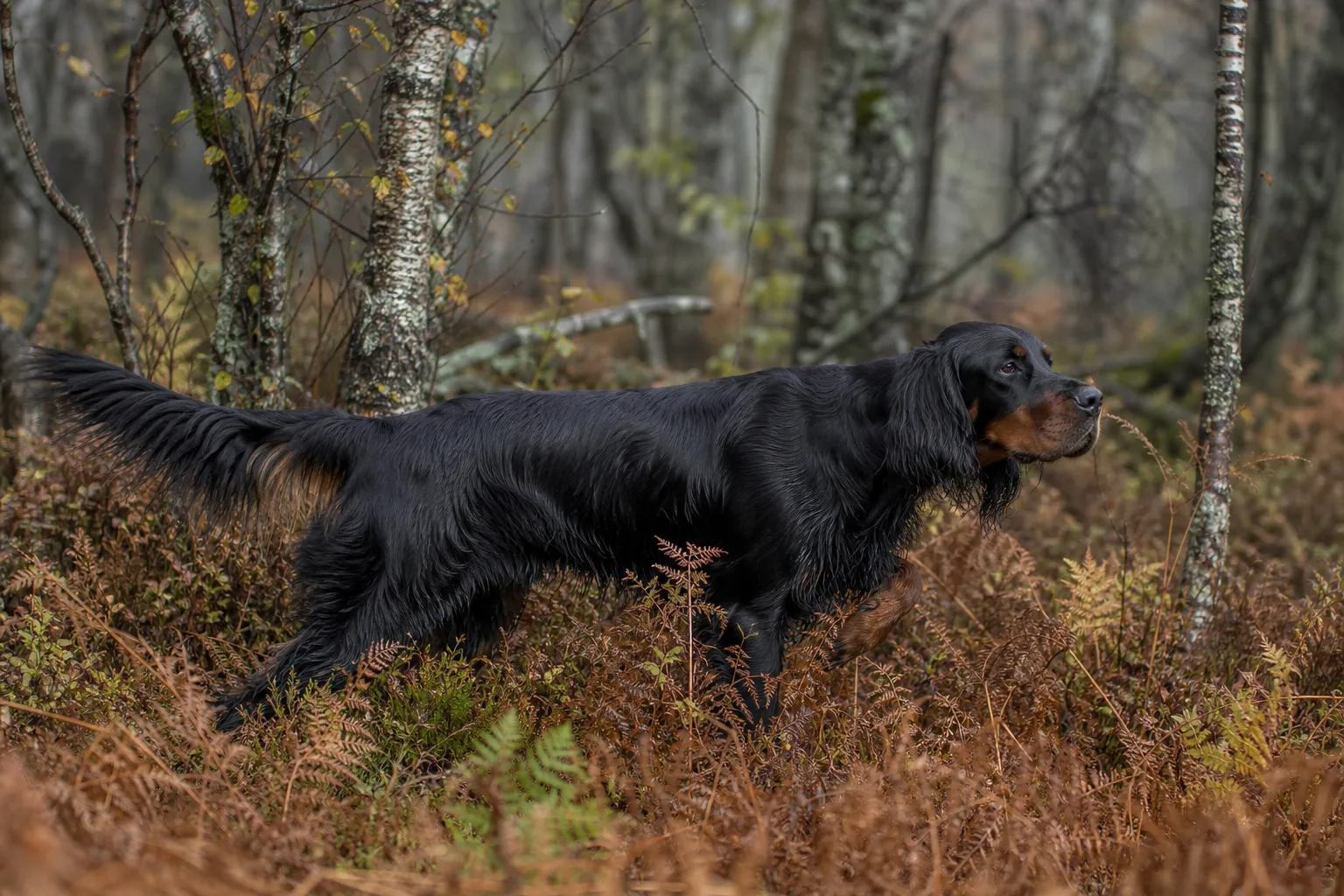

The Gordon Setter is the setter for the hunter who wants one dog, all in, for a lifetime. Scotland’s black-and-tan is the heaviest of the setters, the most deliberate, and the most devoted to a single person. In thick grouse cover, that combination works better than most hunters expect.
Heritage
The Gordon Setter comes from Scotland, where black-and-tan setting dogs were bred for hard days on the moors. The breed takes its name from the Dukes of Gordon, whose kennels at Gordon Castle made the black-and-tan famous among British sportsmen in the early 1800s. These were dogs bred for stamina and thoroughness on wild birds in rough country.
That job description translated. Gordons were among the setters brought to America in the mid-1800s, and the breed found work on ruffed grouse (Bonasa umbellus) and woodcock in the same eastern covers where its English cousin built its legend. The Gordon never matched the English Setter’s numbers in the grouse woods, and it never chased field trial fashion either. While trial breeding pushed other pointing breeds bigger and faster, the Gordon stayed what it was. A strong, careful, close-working meat dog for a walking hunter.
That stubborn consistency is why the breed still fits grouse hunting today. The moors rewarded a dog that checked every likely piece of ground and saved its handler’s legs. Swap heather for aspen and alder, and the same virtues cash in. The Gordon came to the grouse woods less as a convert than as a dog that was already built for the work.
The Mystique
Gordon people will tell you the breed picks its person, and they say it with a certain pride. The one-man dog reputation is the heart of the mystique. A Gordon works for you, watches you, and keys off you in a way that owners describe as closer to partnership than obedience. Hand the whistle to your buddy and the dog will humor him. It will not hunt for him the way it hunts for you.
There is also the look. A black-and-tan setter standing on point in yellow October popple is about as handsome as bird hunting gets, and Gordon owners never tire of it. The coat, the heavy head, and the deliberate way the dog moves give the breed a seriousness the flashier setters do not carry.
Ask around and you hear the same words. Loyal. Honest. A thinking dog. Gordons mature slowly and remember everything, the good lessons and the bad ones. Owners swear the breed keeps a private ledger and hunts hardest for the person whose name fills it. It is a dog you earn, and the people who have earned one rarely switch breeds afterward.
In the Grouse Woods
A Gordon Setter hunts grouse close and methodically, usually 30 to 100 yards, and that pace is the point. The breed works a cover like it is reading every page instead of skimming. In tight young aspen, alder runs, and edge tangles, a deliberate dog bumps fewer birds and pins more of them inside gun range.
You will still lose sight of a black dog in thick cover, sometimes faster than a white one. Run a bell, and add a GPS collar if you hunt big country. A silent bell on a Gordon usually means a point close enough to reach in under a minute.
On running grouse the Gordon’s patience helps. The breed tends to trail carefully and relocate rather than crowd. Woodcock crossover is natural, and the close range makes a Gordon an easy woodcock dog in the flights. One honest caution for early season. That dark coat soaks up sun, so carry water and hunt the shade until the weather turns.
The Other Ten Months
Between seasons a Gordon is a calm, watchful housemate that wants to be wherever you are. The breed is affectionate with its family, polite but reserved with visitors, and quieter indoors than most setters once the exercise box is checked.
Check that box daily. A Gordon needs a real run, not a stroll, and off-season bird work keeps the slow-maturing brain engaged. The feathered coat needs brushing a couple of times a week and a burr comb-out after every hunt. This is a house dog by temperament. A Gordon parked in a kennel away from its person loses the very bond that makes the breed worth owning.
Is This Your Dog?
Get a Gordon Setter if you mostly hunt alone or with one partner, you like a close, thorough dog, and you want a deep bond with a single animal. It suits the patient hunter who values steadiness over speed and does not mind a dog that takes three seasons to finish.
Skip the Gordon if you want a big-running dog, a fast-maturing prospect, or a camp dog that hunts equally for everyone who grabs the whistle. First-time owners can succeed with one, but the breed rewards experience and consistency. Find a breeder whose Gordons actually hunt, because show lines exist here too.
If you like the setter idea with a lighter frame and a wider range, compare the English Setter and its grouse-bred field strain, the Llewellin Setter. Get to know the bird in our ruffed grouse field guide, and since a heavier dog pairs fine with a lighter gun, weigh your options in the 12 vs 20 vs 16 gauge grouse gun comparison. The full breed rundown lives in the grouse dog guide.
FAQ
Gordon Setter questions, answered
Is the Gordon Setter a good grouse dog?
Yes. The Gordon Setter is a genuine grouse dog, bred in Scotland for a full day of careful bird work and well suited to thick North American cover. It hunts closer and more methodically than most setters, which means fewer bumped birds in tight woods. The trade is pace. A Gordon covers ground thoroughly rather than quickly.
How far does a Gordon Setter range when hunting?
Most Gordon Setters work close to medium range, roughly 30 to 100 yards, staying within contact of the gun. The breed was built for thorough, deliberate ground coverage rather than big running. In thick grouse cover that naturally tight range is an asset, and a bell or GPS collar handles the moments the dog slips out of sight.
Why is the Gordon Setter called a one-man dog?
The Gordon Setter earned its one-man reputation because it bonds hard to a single hunter and works noticeably better for that person than for anyone else. The breed is loyal, a little reserved with strangers, and tuned to its owner in the field. That devotion is the breed's signature. Hunters who want a personal dog love it, and hunters who pass a dog around a big camp find it less convenient.
Are Gordon Setters good family dogs?
Yes, Gordon Setters are devoted family dogs that are affectionate with their own people and patient with kids. Expect some reserve around strangers and a strong preference for their favorite person. They need real daily exercise to stay civil in the house, like any setter. A Gordon that hunts in the fall and runs all year is a steady, easy housemate.
Do Gordon Setters shed?
Yes, Gordon Setters shed moderately year-round, and the long feathered coat needs brushing a couple of times a week. The black-and-tan coat also collects burrs and seeds in grouse cover, so plan on a comb-out after every hunt. It is routine maintenance, not a project, but it is more coat than a shorthaired dog carries.