


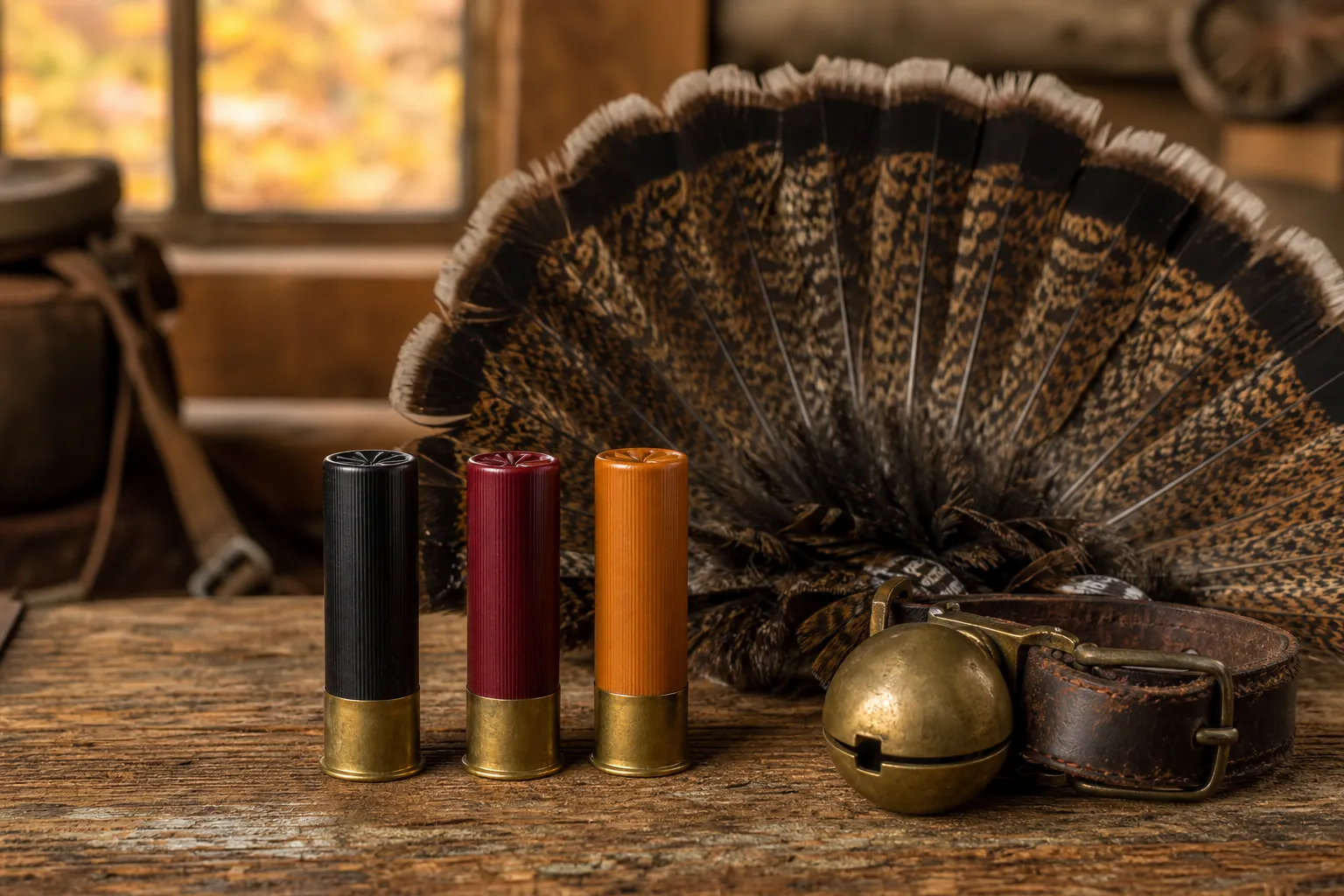

No. 7.5 lead. If you only remember one thing from this page, that is the shot size for ruffed grouse (Bonasa umbellus), all season, everywhere they live. The rest of this article covers when to break that rule, what to shoot at bigger grouse, and how to convert when the rules say non-toxic.
Why does small shot win in the grouse woods?
Because pattern density kills grouse, not pellet energy. A ruffed grouse is a thin-skinned bird that weighs about a pound and a half. It does not take much energy to kill one. It takes pellets actually hitting it, through leaves, through branches, on a bird that is accelerating and turning.
The distances back this up. Foster’s classic New England grouse data, as cited by Project Upland, put the average ruffed grouse kill distance near 23 yards. Most grouse die closer to your boots than you remember afterward. At 23 yards through an open choke, a one ounce load of 7.5s carries roughly 350 pellets into a dense, forgiving pattern. The same ounce of 6s carries about 225. That difference is a hit bird versus a bird that flew through a hole in your pattern.
Big shot solves a problem grouse hunters do not have. Save the pellet energy arguments for pheasants.
How should shot size change through the season?
Start small and go bigger as the woods open up. The bird does not change through the fall. The shooting does.
Early season, opener through leaf drop. Run 8s or 7.5s. Cover is a green wall, flushes come at 10 to 20 yards, and you are shooting at sound and flicker. Maximum pellet count wins here. Bonus: 8s are the right woodcock load, and woodcock share the early cover.
Mid season, leaves down. 7.5s, the standard, in both barrels. Flushes stretch to 20 to 30 yards but the pattern-density math still favors small shot.
Late season, bare woods and snow. 7.5s or 6s. Birds are jumpy, flushes run long, and winter grouse carry more feathers. A 6 holds its pattern and its punch a little farther. This is the one stretch of the year when sizing up earns its keep.
What shot size for each grouse species?
Ruffed grouse rules do not transfer straight across to a four pound sage grouse. Here is the full table.
| Species | Standard load | Early season | Late season |
|---|---|---|---|
| Ruffed grouse | 7.5 lead | 8 lead | 6 lead |
| Sharp-tailed grouse | 7 lead (or 5 steel) | 7s lead or 5s steel | 6 lead or larger |
| Spruce grouse | 7.5 lead | 7.5 lead | 6 lead |
| Dusky (blue) grouse | 7.5 lead | 7.5 lead | 6 lead |
| Sage grouse | 5 or 6 lead | 6 lead | 5 lead |
| Ptarmigan | 7.5 lead | 7.5 lead | 6 lead |
Two notes on the table. Sharptails are covey birds that flush wilder every week of the season, which is why the prairie guys size up as fall runs on. And sage grouse are the largest grouse in North America, a bird that can push seven pounds, so they get treated more like a small goose than a big partridge.
Steel vs lead: how do you convert?
Go up one size when you switch from lead to steel. Steel pellets are lighter than lead pellets of the same diameter, so they shed energy faster. The working conversions for grouse:
- Steel 6 roughly replaces lead 7.5
- Steel 5 roughly replaces lead 6
- Bismuth runs close to lead, so bismuth 5 approximates lead 6, and you can shoot bismuth in older guns that should never see steel
Non-toxic shot is required on many federal waterfowl production areas and some state ground, and grouse cover often sits tight against water. Lead left in wet lowlands is a real toxicity concern for waterfowl and scavengers. Check the regs for the specific ground you hunt, and when in doubt, the steel conversion above costs you nothing inside normal grouse range.
What choke goes with these loads?
Open chokes, always. Cylinder, skeet, and improved cylinder dominate grouse work because they throw wide patterns at the 15 to 25 yards where grouse actually die. Pair 8s and 7.5s with skeet or IC early, and IC or light modified with 6s late if your flushes truly stretch.
Choke and gauge are half of this equation. The full discussion, including which gauge to hang those chokes on, is in our comparison of 12 gauge vs 20 gauge vs 16 gauge for grouse.
The short version fits in a shell pocket. 7.5s in the gun from September to Christmas, 8s while the leaves are up, 6s when the flushes get long, and one size up if the box says steel.
FAQ
Questions hunters ask
What shot size for ruffed grouse?
No. 7.5 lead is the standard shot size for ruffed grouse and works all season. Use 8s early when cover is thick and flushes come inside 20 yards, and 6s late in the year when birds flush at longer range. Grouse are thin-skinned birds killed by pattern density, not pellet energy, so small shot wins.
Can you use steel shot for grouse?
Yes, steel shot kills grouse cleanly, you just need to go up about one size from your lead load. Steel 6s roughly replace lead 7.5s for grouse work. Steel is required on some public ground, including many federal areas, so check the regs where you hunt. Keep your shots inside normal grouse range and steel gives up nothing that matters.
Is 6 shot too big for grouse?
No, 6 shot is not too big for grouse, but it is a late-season choice rather than an all-season one. A load of 6s carries fewer pellets, so patterns get thin at close range through an open choke. Save 6s for the late season, when leaves are down and flushes run long, and for bigger birds like sharptails and sage grouse.
What shot size for sharp-tailed grouse?
No. 7 or 7.5 lead early in the season and No. 6 or larger later is the standard for sharp-tailed grouse, with steel 5s or 6s where non-toxic shot is required. Sharptails are bigger and harder-flushing than ruffed grouse, and shot distances stretch as coveys get wild through the fall. Start small, then size up as the season runs.